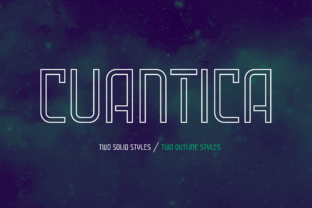
How the Cuantica Family Solves Common Display Design Challenges
When you are searching for a typeface that commands attention without sacrificing readability, the options can feel surprisingly limited. Many display fonts are either too ornamental to be practical or too rigid to convey character. The Cuantica Family bridges this gap effectively. Designed by Pablo Balcells in 2012 for Graviton Font Foundry, Cuantica is a geometric display typeface that delivers visual impact while remaining highly functional across a range of projects. Understanding what this family offers—and how to apply it—can save you hours of trial and error in your next design workflow.
What the Cuantica Family Offers and Why It Matters
At its core, the Cuantica Family is a geometric sans-serif display typeface. It comprises four distinct styles, giving you enough flexibility to build hierarchy and contrast within a single project. The geometric construction means shapes are built from simple, precise forms—circles, straight lines, and consistent stroke weights. This gives Cuantica a clean, modern appearance that works especially well at larger sizes.
For professionals and hobbyists alike, the challenge is often finding a typeface that is distinctive without being distracting. A font that is too playful can undermine credibility. One that is too severe can feel cold or uninviting. Cuantica strikes a balance. Its geometric roots give it a structured, almost architectural feel, while subtle details in letterforms—such as the way bowls connect to stems—add a human touch. This makes it suitable for contexts where you need to convey both professionalism and approachability.
Common Scenarios Where Cuantica Makes a Difference
Imagine you are designing a brand identity for a tech startup. You need a logo mark and supporting typography that feels innovative but not gimmicky. The Cuantica Family can serve as the primary display face for headlines, taglines, and hero sections. Its geometric precision aligns well with industries like software, engineering, and modern architecture. At the same time, the four available styles allow you to differentiate between primary and secondary messaging without leaving the same font family.
Consider a different scenario: you are creating promotional materials for a cultural event, such as a gallery opening or a film festival. Here, you want typography that feels contemporary and artistic. Cuantica’s clean lines and balanced proportions can anchor posters, banners, and social media graphics. Because it is a display typeface, it performs best at medium to large point sizes, which is exactly where posters and digital ads operate. You avoid the common pitfall of using a body font scaled up to headline size, which often looks weak or poorly spaced.
Another frequent need arises in editorial design. Magazines, brochures, and annual reports frequently rely on a limited type palette. The Cuantica Family can fulfill the role of a confident headline face. Its four styles give you room to create visual interest—using a lighter weight for subheadings and a bolder cut for pull quotes or section openers. This keeps the design cohesive without becoming monotonous.
Practical Applications That Deliver Results
To get the most out of the Cuantica Family, consider pairing it with a reliable text face. Because Cuantica is a display typeface, it is not optimized for long body copy at small sizes. A common and effective approach is to use Cuantica for headings, subheadings, and navigation elements, while selecting a neutral serif or sans-serif for paragraphs. This combination preserves readability and leverages Cuantica’s strengths where they shine most.
For example, in a landing page design, you might set the main headline in Cuantica’s boldest style. The geometric forms will catch the eye immediately. Below that, use a clean sans-serif like Open Sans or Lato for the supporting text. The contrast in weight and structure creates a clear visual hierarchy, guiding the reader naturally from the headline to the call-to-action.
In logo design, Cuantica can be used as the basis for a wordmark, especially for brands that want to communicate clarity and forward-thinking values. The consistent stroke widths and circular shapes make the lettering feel balanced and intentional. You may want to customize spacing or modify certain characters to make the logo unique, but the foundation is solid enough to start from.
Another strong use case is in presentation decks. Whether you are building slides for a pitch or an internal training session, Cuantica can make your titles and key data points stand out. Use it for slide headers, statistic callouts, and section dividers. Because it is a display face, it reads clearly from a distance, which is essential in conference rooms or webinar settings.
How Different Users Can Approach Cuantica
Your experience level and project type will influence how you use the Cuantica Family. A graphic designer working on a branding project will likely experiment with all four styles to find the right voice for the client. They may also adjust kerning or tracking to fine-tune the appearance, since geometric fonts sometimes require manual spacing adjustments at certain sizes.
A small business owner creating their own marketing materials might take a simpler route. They can choose one or two styles from the Cuantica Family and apply them consistently across their website, flyers, and social media graphics. The built-in cohesion of the family reduces the risk of mismatched typography, which is a common issue when mixing fonts from different typefaces.
Students and educators can also benefit. In a typography or graphic design course, Cuantica serves as a good example of geometric type design. Analyzing its letterforms can help students understand the principles of geometric construction and how small design decisions affect readability and tone. For project work, it offers a professional-grade option that is easy to implement without requiring extensive font licenses.
Useful Considerations Before You Start
Before you integrate the Cuantica Family into your work, there are a few practical considerations to keep in mind. First, because it is a display typeface, it is best suited for sizes above 18 points. Using it at smaller sizes can cause loss of detail and reduce legibility, especially in digital environments with lower resolution screens. Always test your design at the actual size it will be viewed.
Second, consider the medium. Cuantica works well in both print and digital contexts, but the rendering can differ. On screen, especially at larger sizes, the geometric shapes tend to hold up well. In print, make sure the paper stock and printing method support fine details. For high-end print projects, a proofing step is recommended.
Third, think about color and background. Geometric typefaces like Cuantica often pair beautifully with solid backgrounds, gradients, or photographic images with consistent lighting. Avoid placing it over busy or highly textured backgrounds, as the clean lines may compete with the visual noise. Instead, use ample contrast and consider adding a subtle drop shadow or background treatment to ensure readability.
Outcomes You Can Expect with the Cuantica Family
When used thoughtfully, the Cuantica Family can elevate the professionalism and visual appeal of your projects. You can expect clearer hierarchy, stronger brand recognition, and a modern aesthetic that resonates with contemporary audiences. Because the family offers four styles, you gain flexibility without sacrificing consistency. This means less time searching for complementary fonts and more time refining your design.
Users who adopt Cuantica often report that it simplifies their decision-making process. Instead of juggling multiple typefaces with conflicting personalities, they rely on one family to handle display needs. This streamlined approach reduces cognitive load and leads to cleaner, more cohesive final products.
Additionally, because Cuantica was designed by Pablo Balcells for Graviton Font Foundry, you benefit from professional-grade construction. The spacing, kerning, and overall balance have been refined by an experienced type designer. This attention to detail is something that sets foundry typefaces apart from free alternatives. While free fonts can serve in a pinch, they often lack the polish needed for client-facing work or public-facing materials.
Final Recommendations for Getting Started
If you are new to the Cuantica Family, begin by exploring all four styles in a test document. Set sample headlines, subheadings, and short phrases to see how each weight behaves. Pay attention to how the typeface interacts with your chosen color palette and layout grid. Experiment with pairings—try it alongside a neutral sans-serif for a clean look, or with a contemporary serif for added contrast.
For existing projects, consider swapping out your current display typeface with Cuantica in a few key areas. You may find that the geometric precision improves the overall polish without requiring a full redesign. This is especially useful for updating older materials that feel dated.
Finally, remember that good typography is about serving the reader. The Cuantica Family is a tool to help you communicate more effectively. Use it where you need clarity, impact, and a modern edge. Avoid overusing it in places where a less assertive typeface would serve better. With thoughtful application, Cuantica can become a reliable part of your design toolkit—one that helps you meet your goals and exceed expectations.