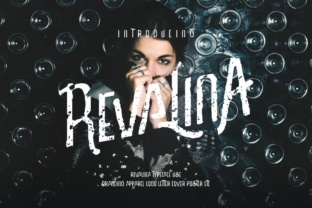
Revalina in Practice: A Vintage Display Type for Expressive Design Projects
Choosing the right typeface for a project often means balancing personality with readability. Among the many options available, Revalina stands out as a vintage display type that carries a distinct, expressive character. Whether you are designing a logo, a poster, or a product label, understanding what Revalina offers—and where its limitations lie—can help you decide if it fits your next project.
What Defines Revalina as a Display Typeface
Revalina is not a neutral, everyday text font. It belongs to the category of display typefaces, which are designed primarily for headlines, short passages, and visual emphasis. Its vintage inspiration is immediately visible in the letterforms: there is a hand-drawn quality, slight irregularities, and a warmth that recalls letterpress printing and mid-century signage. This makes Revalina especially suitable for projects where you want to evoke nostalgia, craftsmanship, or a sense of history.
The expressiveness of Revalina comes from its balance between structure and spontaneity. The characters are legible but not rigid, with subtle variations in stroke width and curvature that give it a human touch. For designers looking to break away from sterile, geometric fonts, Revalina offers a breath of personality without sacrificing clarity.
Comparing Revalina with Other Vintage and Display Options
When you place Revalina alongside other vintage-inspired display fonts, several distinctions emerge. Many retro typefaces lean heavily into a specific decade—Art Deco, 1950s script, or Victorian ornamentation. Revalina, by contrast, occupies a more general vintage space. It does not scream a particular era, which gives it versatility across different historical references.
Compared to modern display fonts that emphasize minimalism or high contrast, Revalina feels approachable and warm. Its expressiveness is subtle enough to work in professional contexts, yet distinct enough to add character. If you need a font that feels both familiar and unique, Revalina strikes that balance well.
However, it is important to recognize that Revalina is not designed for extended body text. Its display nature means that using it for long paragraphs will tire the reader. This is where a comparison with standard serif or sans-serif text fonts becomes relevant. Revalina is best paired with a simpler, more neutral typeface for body copy, allowing it to shine in headings and accents without overwhelming the layout.
Strengths and Best-Fit Situations for Revalina
Revalina excels in contexts where the typography itself carries meaning. Here are several scenarios where it proves particularly effective:
- Branding and logo design: Small businesses, artisan products, and creative agencies often need a typeface that communicates authenticity. Revalina lends a handcrafted feel that aligns with brands centered on quality, tradition, or artistic expression.
- Event posters and invitations: Concerts, gallery openings, markets, and weddings all benefit from a typeface that feels special. Revalina adds a celebratory, warm tone that standard fonts lack.
- Packaging and labels: Food, beverage, and beauty products that emphasize natural ingredients or heritage production methods can use Revalina to support that narrative visually.
- Editorial and magazine headings: For feature articles or sections that need to stand apart, Revalina provides enough weight and character to draw attention without resorting to overly decorative treatments.
- Digital headers and hero sections: Even in web design, a carefully placed heading in Revalina can create a memorable first impression, especially when paired with clean body text.
In each of these cases, Revalina performs best when used at a medium to large size. Its details become apparent at larger scales, and its expressiveness is most effective when the viewer has room to appreciate the letterforms.
Tradeoffs and Limitations to Consider
No typeface works everywhere, and Revalina has its share of tradeoffs. The most obvious limitation is legibility at small sizes. Because it is a display type, reducing it below 12–14 points can cause the finer details to blur, especially on screens. For body text, captions, or footnotes, you will almost certainly need a complementary text font.
Another consideration is the vintage aesthetic itself. While Revalina is not locked into a single era, it still carries a nostalgic tone. If your project demands a futuristic, corporate, or ultra-modern look, Revalina may feel out of place. Its warmth and expressiveness can clash with minimalist layouts that rely on strict geometry and coldness.
Additionally, Revalina might not offer the extensive character set or language support that some global projects require. Before committing to it, check whether the glyph coverage meets your needs, especially if you are working with multiple languages or special punctuation.
Finally, overuse can diminish its impact. Because Revalina is so expressive, using it too frequently within a single piece can create visual noise. Restricting it to headlines or key accents preserves its effectiveness.
When You Might Need an Alternative to Revalina
There are clear scenarios where another typeface may serve you better. If your primary requirement is high-density text reading—such as books, reports, or lengthy articles—a text-focused serif or sans-serif will outperform Revalina in every respect. Similarly, if you need a font that scales down well for small UI elements or mobile interfaces, a more neutral and robust display font might be preferable.
For projects that demand a very specific historical period, such as Roaring Twenties glamour or 1970s psychedelia, a more era-specific typeface may give you a tighter match. Revalina covers a broad vintage range, but it does not replicate any single period with precision.
If your design calls for extreme weight variation, sharp geometric forms, or a minimalist aesthetic, Revalina will feel out of step. In those cases, explore fonts designed explicitly for those styles. The key is to match the typeface's core personality to your project's overall tone.
Decision Factors for Choosing Revalina
When evaluating whether Revalina is right for you, consider these factors:
- Project context: Is the design meant to feel warm, nostalgic, or handcrafted? If yes, Revalina is a strong candidate.
- Scale and placement: Will the font be used primarily for large headings or short text blocks? If so, Revalina will perform well.
- Complementary pairings: Do you have a neutral body font ready to pair with it? A clean sans-serif or straightforward serif often works best with Revalina.
- Audience expectations: Will your readers respond well to a vintage feel? For younger or tech-focused audiences, consider whether the nostalgia aligns with your message.
- Usage constraints: Check licensing, language support, and file formats before finalizing your choice.
These factors are not exhaustive, but they give a practical starting point. Revalina can be a powerful tool when used deliberately, and understanding its strengths and boundaries helps you avoid common mismatches.
Practical Examples of Revalina in Action
Imagine a small-batch coffee roastery launching a new blend. The packaging uses Revalina for the product name, set in a warm cream on a kraft paper background. The result feels authentic and artisan, matching the brand's story. The ingredient list and brewing instructions, meanwhile, use a simple sans-serif that does not compete with the headline. Here, Revalina carries the emotional weight of the design.
Consider a music festival poster for a folk and roots event. The lineup is set in Revalina at varying sizes, with each artist name given enough space to breathe. The poster feels lively but not chaotic, and the vintage tone signals the genre before anyone reads a word. A modern sans-serif would not convey the same atmosphere.
On the other hand, think about a tech startup's website trying to appear cutting-edge. Using Revalina for the main heading would send a mixed message. The same startup could use Revalina only in a small, stylized logo mark if they wanted a hint of warmth, but the primary typography should align with the brand's forward-looking identity.
Making an Informed Decision
Revalina is a tool, not a solution. Its value depends entirely on how well it fits your project's purpose, audience, and visual language. By understanding its vintage expressiveness, its display nature, and its limitations, you can decide if it is the right choice or if you need to look elsewhere.
For designers and project owners who value character and warmth, Revalina offers a distinct option that stands apart from the crowd. For those who need neutrality, precision, or extensive text support, other typefaces will serve better. The key is to match the tool to the task, and Revalina is best reserved for tasks that benefit from a touch of expressive, vintage personality.
When you are comparing options, give Revalina a close look. Test it at the sizes and contexts you plan to use. Pair it with potential body fonts. Let the project itself guide the decision, and you will know whether Revalina is the expressive display type you need.