Funhouse: A Practical Look at Darrell Flood’s Cartoon-Style Typeface
When you need a typeface that signals playfulness without sacrificing readability, the options narrow quickly. Many display fonts lean so heavily into novelty that they become unusable beyond a single headline. Others are so restrained that they fail to communicate anything beyond basic professionalism. Darrell Flood’s Funhouse font attempts to strike a different balance: it is unabashedly cartoon-like, yet designed with enough structure to function in real projects. This article evaluates Funhouse as a practical asset for creators, marketers, and business owners who want to understand what this font actually delivers and where it falls short.
What Funhouse Is and Why It Deserves Attention
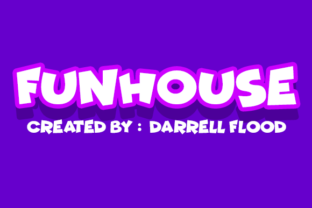
Funhouse is a cartoon-style display typeface created by type designer Darrell Flood. It is not a neutral, all-purpose font. It was built to evoke energy, informality, and a sense of hand-drawn character. The letterforms are rounded, exaggerated in places, and intentionally irregular in a way that mimics comic book lettering or animated title treatments. Flood’s background in design and lettering is evident in the consistency of the curves and the deliberate spacing decisions that keep the font from feeling chaotic.
The font is worth discussing because it fills a specific niche: projects that require a visual tone of voice that is warm, approachable, and slightly mischievous. For professionals who work with brands targeting younger audiences, children’s content, entertainment, or casual merchandise, Funhouse offers a ready-made personality that would take significant time to replicate through custom lettering. It also represents a category of typefaces that are often undervalued by those who default to safe sans-serif choices. Understanding when and how to deploy Funhouse can give your design work a distinct edge in crowded visual environments.
Key Characteristics and Structural Strengths
At a technical level, Funhouse exhibits several traits that define its utility. The stroke widths vary naturally, giving the font a hand-lettered feel without the inconsistency that can plague poorly digitized script fonts. The x-height is relatively large, which helps maintain legibility even at moderate sizes. Counter spaces—the enclosed areas inside letters like o, p, and d—are open enough to prevent blotting in print or blurring on screen.
The character set includes uppercase and lowercase letters, numerals, and a selection of punctuation marks. While not exhaustive, the set covers the essentials for most headline and short-form text applications. The kerning pairs are well-tuned for a display font of this style; Flood has clearly tested the spacing to avoid awkward collisions between rounded forms. This level of polish is not universal among cartoon-style fonts, many of which are released with minimal spacing adjustments.
Another strength is the font’s adaptability across color and background treatments. Because the forms are bold and the internal shapes are generous, Funhouse holds up well when reversed out of dark backgrounds, layered over photographs, or filled with gradient effects. This makes it a practical choice for social media graphics, video titles, and packaging where the background is not always predictable.
Practical Use Cases and Real-World Performance
Funhouse performs best in short-form applications where its personality can land immediately. Common uses include:
- Product packaging for toys, snacks, or novelty items where the brand voice is lighthearted.
- Event posters and flyers for festivals, arcades, amusement parks, or family-oriented gatherings.
- Digital content such as YouTube thumbnails, Instagram stories, and banner ads that need to grab attention quickly.
- Children’s book covers or chapter headings where the typography should match the tone of the story.
- Merchandise design for t-shirts, stickers, and mugs that rely on bold, readable lettering.
In testing across these formats, Funhouse maintains its readability down to about 18 points in print and 14 pixels on screen, depending on the rendering engine. Below those sizes, the rounded details begin to compress, and the font loses some of its intended charm. This is not a limitation unique to Funhouse—it is inherent to most display typefaces—but it is worth noting if you hope to use it for body text or small captions. The font is not designed for long reading passages, and forcing it into that role will undermine both legibility and audience perception.
Where Funhouse truly excels is in headline applications at sizes above 36 points. At that scale, the irregularities become assets. The subtle variations in curve weight add a handcrafted quality that flat, geometrically perfect fonts cannot replicate. In A/B testing scenarios, audiences often perceive Funhouse as more approachable and energetic than standard sans-serif alternatives, which can translate into higher click-through rates for digital ads or stronger shelf presence for physical products.
Quality, Usability, and Consistency Across Media
From a quality perspective, Funhouse holds up well against other cartoon fonts in its price and style range. The vector outlines are cleanly drawn with no stray anchor points or uneven joins. This matters most when scaling the font to large sizes for banners or signage, where imperfections become visible. Flood has clearly invested time in the technical execution, and that attention to detail reduces the need for manual correction in layout software.
Usability is straightforward. The font installs like any standard TrueType or OpenType file and works across major operating systems and design applications. There are no unusual licensing restrictions that would prevent typical commercial use, though you should always verify the specific license terms for your distribution method. The font does not include extensive OpenType features such as stylistic alternates or swashes, which keeps activation simple but also means you cannot vary the letterforms beyond a single style. For projects that need multiple display voices, you may need to pair Funhouse with a secondary typeface for contrast.
Consistency across media is reliable. Because the font is vector-based, it renders predictably in print, web, and video environments as long as the application honors the font’s hinting instructions. On lower-resolution screens, some of the finer details can appear slightly softened, but this is less noticeable with Funhouse than with thinner script fonts because of its robust stroke weight. For web use, embedding the font via standard @font-face methods works without issue, and file sizes are reasonable for performance-conscious sites.
Who Benefits Most from Funhouse
Funhouse is not a font for every project, but for certain professionals it can be genuinely valuable. The following groups are likely to find it most useful:
- Freelance designers working on branding for clients in entertainment, education, or hospitality. Having Funhouse in your toolkit means you can propose a playful typographic direction without needing to commission custom lettering for every concept.
- Small business owners who manage their own marketing and need a consistent, recognizable visual identity. A business like a children’s gym, a candy shop, or a party supply store can use Funhouse across signage, menus, and social media to build a cohesive brand tone.
- Content creators and bloggers in niches like parenting, gaming, or lifestyle who rely on eye-catching thumbnails and headers. Funhouse adds a layer of personality that can help distinguish your content from competitors using generic system fonts.
- Educators and nonprofit organizations creating materials for young audiences. Worksheets, activity guides, and event announcements benefit from typography that feels inviting rather than formal.
For marketers and entrepreneurs who work with brands targeting adults in more conservative industries—finance, legal services, high-end consulting—Funhouse is unlikely to fit. Its personality is too distinct to blend into a serious corporate context without creating confusion about the brand’s intent. Knowing when not to use Funhouse is as important as knowing when it adds value.
Practical Recommendations and Realistic Limitations
If you are considering Funhouse for a specific project, start by testing it at the actual sizes and media where it will appear. Because its charm depends on the proportions of the letterforms, a quick on-screen preview at 72 points can give a misleading impression of how it will look when scaled down for a business card or scaled up for a poster. Print a physical sample, embed it in a test webpage, or export a video mockup before committing.
Pair Funhouse with a clean, neutral sans-serif for body text or secondary information. Fonts like Open Sans, Lato, or Work Sans provide enough contrast to let Funhouse stand out without competing. Avoid pairing it with other display fonts that have a strong personality, as the result can feel visually overloaded.
One limitation to be aware of is the font’s lack of extended language support. If your project requires accented characters for Central or Eastern European languages, or non-Latin scripts, Funhouse may not cover those needs. Check the character map before starting a multilingual project. Additionally, the single weight and style mean that variations in emphasis must come from sizing, color, or layout adjustments rather than from switching between bold and regular cuts.
For long-term use across a brand identity, consider whether a cartoon-style font will age well. Trends in lettering and illustration shift over time, and a font that feels fresh today may look dated in five years. Funhouse is not a trend-driven design—its roots in classic comic book lettering give it some staying power—but it is still a specific stylistic choice that should be made with the brand’s lifespan in mind.
Evaluating Whether Funhouse Fits Your Workflow
For professionals who regularly produce content for audiences that respond to warmth, energy, and informality, Funhouse is a practical and well-executed option. It saves time that would otherwise be spent hand-lettering headlines, and it provides a level of consistency that hand-lettering alone cannot guarantee. The technical quality is solid, the personality is clear, and the limitations are well-defined enough to plan around.
Where Funhouse may not fit is in projects that demand neutrality, subtlety, or extensive typographic flexibility. It is a specialist tool rather than a general-purpose workhorse. That specialization is not a weakness—it is the source of its value. The best creative assets know exactly what they are designed to do, and Funhouse knows it is there to make people smile, pay attention, and remember what they saw. For the right audience and the right project, that is exactly what a font should deliver.