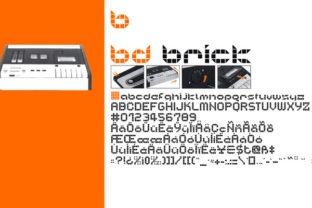
BD Brick: A Practical Look at a Matrix Font with Lasting Value
When a typeface survives for nearly three decades, it is worth examining why. BD Brick first appeared in 1996 as a matrix font and was later updated in 2007 as an OpenType font with additional characters. Created by Lopetz of Büro Destruct for typedifferent.com, it occupies a specific niche that remains relevant for designers, publishers, and content creators who value structure, legibility, and a controlled aesthetic. This article offers a professional evaluation of BD Brick, its characteristics, practical uses, and the audiences most likely to benefit from it.
What BD Brick Is and Why It Still Matters
BD Brick is a matrix font, meaning its letterforms are constructed on a grid-like system where each character is built from a series of blocks or "bricks." This approach gives the typeface a distinctive, pixel-inspired appearance that evokes early digital displays, architectural drafting, and modular design systems. The original 1996 release captured a moment when digital typography was exploring the boundaries of screen resolution and pixel art. The 2007 update brought the font into the OpenType era, adding extended character support, improved kerning, and better compatibility across modern operating systems and applications.
What makes BD Brick worth discussing in 2025 is not nostalgia alone. The font occupies a practical middle ground between purely decorative pixel fonts and utilitarian monospaced families. It offers enough structure to be reliable for specific use cases, yet enough personality to stand out when a project calls for a clean, mechanical, or retro-modern tone. The update to OpenType ensured that the font works across contemporary design software, web platforms, and print workflows without the technical limitations that plagued many late-1990s typefaces.
Key Characteristics and Design Strengths
BD Brick's most defining feature is its modular construction. Each glyph is composed of rectangular blocks that align to a strict grid, giving the typeface a uniform, almost architectural quality. This creates a visual rhythm that works well for headlines, short text blocks, and interface elements where clarity at small sizes is critical. The matrix structure also means the font performs predictably across different rendering environments, from high-resolution Retina displays to lower-resolution screens where anti-aliasing can sometimes soften other typefaces into illegibility.
The 2007 update added significant practical value. Additional characters expanded language support, making the font more useful for international projects. OpenType features, including improved kerning pairs and better spacing, addressed some of the shortcomings of the original release. The result is a font that feels more polished and versatile while retaining the core visual identity that defined it from the start.
Legibility is a genuine strength of BD Brick when used at appropriate sizes. The blocky construction eliminates ambiguity between similar characters—lowercase L and uppercase I, for example, are clearly distinguishable. This makes the font suitable for signage, labels, data displays, and other contexts where misreading a character could cause confusion. The uniform stroke width also contributes to a consistent texture on the page or screen, reducing visual noise in information-dense layouts.
Practical Value in Real-World Use
From a professional standpoint, BD Brick shines most in applications where a structured, no-nonsense appearance is desired. Consider a small business owner designing a menu board for a café with an industrial or minimalist theme. The grid-based letterforms complement exposed brick walls, metal fixtures, and simple typography. The font's rigid geometry reinforces the visual message of honesty, craftsmanship, and deliberate design. It does not try to be elegant or flowing—it is direct, which is precisely what such a setting requires.
For marketers and content creators producing digital assets for tech-focused brands, BD Brick can serve as a headline font that signals precision and system thinking. It pairs well with sans-serif body fonts like Helvetica, Inter, or Roboto, creating a contrast between the rigid matrix letterforms and smoother reading text. This kind of pairing adds visual interest without requiring decorative flair or excessive ornamentation.
Freelancers and designers working on branding for startups, workshops, or creative studios may find BD Brick useful for logotypes, badges, or wordmarks that need to communicate a handcrafted yet systematic identity. The font's limited character—it will never look soft, organic, or ornate—becomes an advantage when the goal is to stand out through constraint. A logo set in BD Brick says "we build things thoughtfully," which resonates with audiences who value process and precision.
Educators and publishers producing instructional materials, worksheets, or visual aids may appreciate the font's clarity at larger sizes. The matrix construction makes each letterform unmistakable, which can benefit early readers or learners who are still developing letter recognition. Headings and labels in BD Brick can break up dense information without introducing decorative distractions that compete with content.
Quality, Usability, and Long-Term Value
BD Brick is a well-executed example of a niche typeface. The quality of the design is consistent: each glyph follows the same grid logic, spacing is even, and the overall weight distribution is balanced. The OpenType update addressed technical quality by ensuring proper character encoding, Unicode coverage, and compatibility with modern layout engines. From a reliability standpoint, the font works as expected across major design tools including Adobe Creative Suite, Figma, Sketch, and web-based platforms via @font-face embedding.
Usability is good for a display font but limited for extended body text. Setting long paragraphs in BD Brick at small sizes will fatigue readers because the blocky shapes lack the subtle curves and optical adjustments that make continuous reading comfortable. This is not a flaw—it is a matter of appropriate use. Professionals who understand type classification will recognize BD Brick as a display or accent typeface and plan their layouts accordingly. Using it for headlines, pull quotes, subheads, and short callouts maximizes its strengths while avoiding its weaknesses.
The long-term value of BD Brick depends on how well it fits a given design system. For projects that change direction frequently, the font may feel too specific. But for brands, publications, or interfaces with a consistent visual language, BD Brick can become a signature element that customers recognize over time. Its uniqueness works in its favor here: very few typefaces look like it, so repeated use builds association.
Audience Fit: Who Benefits Most from BD Brick
BD Brick is not a universal solution, and it is not intended to be. The audience that benefits most includes:
- Small business owners with brick-and-mortar spaces who need signage, menus, or promotional materials that reflect a structured, industrial, or modern aesthetic.
- Freelance designers and creative studios working on branding projects for clients in technology, architecture, fabrication, or engineering where precision is a brand value.
- Marketers and content creators producing digital assets for brands that want to convey system thinking, clarity, or a retro-digital vibe without looking dated or gimmicky.
- Educators and publishers creating instructional materials, posters, or learning aids where letterform clarity at large sizes supports comprehension.
- Bloggers and serious hobbyists building personal brands or content hubs around topics like design, urban planning, DIY, or technology—areas where a matrix font reinforces the subject matter.
Entrepreneurs launching products or services that emphasize structure, simplicity, or authenticity may also find BD Brick useful for packaging, labels, or web headers. The font communicates that the maker has thought about details, which builds trust with discerning customers.
Practical Recommendations and Considerations
If you are evaluating BD Brick for a project, start by testing it at the sizes and contexts where it will actually appear. Set a headline in the font and look at it on the screen, in a print proof, and, if possible, in the physical environment where it will be seen. The matrix construction behaves differently across materials and lighting conditions—on a backlit sign, the blocky shapes can appear crisp and dimensional; on uncoated paper, they may feel heavier.
Consider pairing BD Brick with a neutral sans-serif body typeface that does not compete for attention. Avoid pairing it with other decorated or display fonts, as the result can become visually chaotic. A restrained palette—one display font, one body font, a limited color scheme—lets the matrix letterforms do their work without distraction.
Be aware of the font's limitations. It lacks italic variants and has only one weight in most distributions. This means you cannot rely on style changes within the typeface itself to create hierarchy; you will need to use size, color, or spacing instead. For projects that require extensive typographic flexibility, BD Brick may serve better as a supporting element rather than the primary typeface.
Licensing is another consideration. BD Brick is available through typedifferent.com, and like most commercial typefaces, the license terms dictate how it can be used in web, print, and application contexts. Read the license carefully if you plan to use the font for commercial products, particularly if you intend to embed it in software or sell designs that incorporate it.
Final Observations
BD Brick is a typeface with a clear point of view and a disciplined execution. It does not try to be everything to everyone, and that restraint is precisely what makes it valuable for the right projects. Its matrix construction offers a level of clarity and consistency that many more flexible fonts cannot match, and its OpenType update ensures it remains usable in contemporary workflows. For professionals and creators who need a font that communicates structure, precision, and intentionality, BD Brick is worth considering. Test it, pair it thoughtfully, and use it where its strengths align with your goals. That is the most honest evaluation any typeface can earn.