Descuadrado: The Unsquared Font That Breaks the Grid
Most fonts live inside neat, predictable boxes. Every letter sits within a uniform frame, aligned to invisible guides that ensure order and consistency. That works beautifully for body text and corporate reports. But sometimes, you need something that doesn't fit the mold. That's where Descuadrado comes in. This unsquared font family, available in Regular, Bold, and Hollow Outline variations, deliberately steps outside the conventional typographic grid to deliver something more expressive, more human, and undeniably distinctive.
If you've ever felt constrained by standard typefaces or struggled to find a font that conveys energy without sacrificing readability, Descuadrado deserves a closer look. It's not trying to be a neutral workhorse. Instead, it brings personality, motion, and a handcrafted feel to everything it touches.
What Exactly Is Descuadrado?
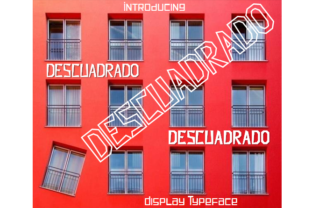
Descuadrado is a display-oriented font family built around the concept of deliberate imperfection. The Spanish name translates roughly to "unsquared" or "off-square," which perfectly describes its core design philosophy. Each character carries subtle irregularities—slightly tilted angles, uneven strokes, and a general sense of being hand-drawn rather than machine-perfect.
The family includes three distinct styles:
- Regular — A solid, approachable version that balances readability with character. This is your go-to for headlines, signage, and any situation where you want the font's personality front and center without overwhelming the message.
- Bold — An amplified version that cranks up the presence. Thicker strokes and more pronounced irregularities make this ideal for strong statements, posters, or brand elements that need to command attention.
- Hollow Outline — A negative-space version that creates a stencil-like, airy feel. This style works especially well for layered designs, overlays, or any context where you want the shape of the letters to define the visual rather than the fill.
Together, these three variations give you a surprisingly versatile toolkit. You're not locked into one mood. You can shift between solid and outline, between moderate and bold, depending on the medium and message.
Why Unsquared Fonts Work in a Square World
We consume an enormous amount of perfectly aligned digital content every day. Apps, websites, documents, interfaces—they all rely on clean grids and uniform type. That consistency is essential for usability, but it also creates a kind of visual sameness. When every piece of text looks polished and predictable, nothing stands out.
Descuadrado disrupts that monotony. Its unsquared letterforms introduce a human element that's increasingly rare in modern design. The slight wobbles and uneven weights evoke hand lettering, chalkboard signs, or custom typography from a local shop. That warmth creates an immediate emotional connection that sanitized fonts rarely achieve.
From a branding perspective, this is gold. Consumers are bombarded with thousands of polished messages daily. Anything that feels handmade, real, or slightly imperfect cuts through the noise. Descuadrado gives your work that tactile, analogue quality even when it's displayed on a digital screen.
Practical Applications Across Real-World Contexts
One of the most appealing things about Descuadrado is how adaptable it proves across different environments. Let's walk through some concrete scenarios where each style shines.
Small Business and Retail Branding
Imagine a coffee shop, a craft brewery, or a boutique clothing store. These businesses thrive on personality. A clean sans-serif font might feel sterile and corporate, while a script or decorative font can become unreadable at small sizes. Descuadrado Regular offers a sweet spot. It reads clearly on signage, menus, and packaging, yet it carries enough character to reinforce a local, artisanal vibe.
The Bold style works beautifully for window decals or promotional banners where you need the text to carry across a distance. And the Hollow Outline version? Try it on glass doors, coffee sleeves, or as an overlay on product photography. The negative space lets background textures peek through, creating depth without extra graphics.
Digital Content and Social Media
Content creators and marketers know that stopping the scroll is half the battle. Descuadrado's irregular forms naturally catch the eye because they don't look like every other Instagram story or YouTube thumbnail font. Use Regular for short quote cards, Bold for channel art or video titles, and Hollow Outline for layered text effects that sit on top of images or gradients.
One practical tip: Because Descuadrado leans toward display use, keep it for headlines, titles, and short emphasis phrases rather than long captions or body copy. Pair it with a simple sans-serif for paragraphs to maintain readability while preserving the visual punch.
Educational and Workshop Materials
Teachers, trainers, and workshop facilitators often rely on visual materials that need to feel engaging without becoming distracting. Descuadrado Regular works well for presentation titles, workbook covers, and classroom posters. Its hand-drawn character suggests creativity and approachability, which can help lower the formality barrier in learning environments.
The Hollow Outline style is particularly clever for coloring activities, fill-in-the-blank worksheets, or any material where students interact directly with the typography. The open letterforms invite participation in a way that solid fonts don't.
Event and Publication Design
Flyers, posters, zines, and event programs all benefit from typography that carries its own visual weight. Descuadrado Bold is practically built for bold headlines that need to read from across the room. Combine it with the Regular style for subheadings or author names, and use Hollow Outline sparingly for decorative accents or pull quotes.
In print, the thickness of the Bold style also holds up well against textured paper stocks. If you're designing for risograph, screen printing, or digital press, the irregularities in Descuadrado tend to reproduce nicely because they already embrace the imperfections inherent in those printing methods.
Usability and Practical Considerations
No font is perfect for every job, and Descuadrado has its sweet spots. Here are some observations based on real usage that might help you decide if it's right for your project.
Readability matters at scale. At larger sizes—36 point and above—Descuadrado shines. The details in the letterforms become visible, and the unsquared quality feels deliberate and artistic. At smaller sizes, especially below 18 point, some of the subtle irregularities can start to feel muddy. Reserve it for headings, labels, or short callouts where the font can breathe.
Pairing is key. Because Descuadrado carries such strong personality, it works best when paired with a neutral partner. Consider a clean geometric sans-serif like Montserrat or a reliable workhorse like Open Sans for your body text. The contrast will emphasize Descuadrado's uniqueness without overwhelming the page.
Letter spacing deserves attention. The unsquared shapes mean that some letter combinations may feel tighter or looser than you'd expect. Don't be afraid to adjust tracking manually for specific headlines or logos. A little extra breathing room often helps the irregularities read as intentional rather than accidental.
Web use requires care. If you're using Descuadrado on a website, pay attention to load times and rendering. Display fonts with non-standard shapes can sometimes render inconsistently across browsers at smaller sizes. Use it in CSS for headings and ensure you have a fallback stack that still looks intentional. Serving the font as a web font with proper subsetting will keep file sizes manageable.
Who Benefits Most from Descuadrado
In my experience, Descuadrado resonates most with people who want their work to feel distinctive without resorting to gimmicks. It's a confident choice for anyone who needs to communicate authenticity, creativity, or a handcrafted ethos.
- Freelancers and solopreneurs can use it to build a visual identity that feels personal rather than corporate, even on a tight budget.
- Marketers and brand managers will appreciate how easily it differentiates a campaign from the competition, especially in local or lifestyle-oriented markets.
- Educators and publishers can leverage its friendly character to make materials feel more inviting and less institutional.
- Hobbyists and creators working on personal projects, merch, or side hustles will find the three-style family gives them enough flexibility to experiment without needing a full type library.
If you're a designer who works with startups or food-and-beverage brands, Descuadrado should probably be in your back pocket. It solves that recurring problem of wanting something unique but still professional. It's not a novelty font in the way a script or display-only face might be. It's a genuinely usable tool with a distinct voice.
Final Observations
Descuadrado fills a specific gap in the typography landscape. It proves that imperfection, when handled intentionally, can be more communicative than precision. The three styles—Regular, Bold, and Hollow Outline—cover enough ground that you can build a coherent visual system around them, especially for projects where warmth and authenticity matter more than clinical neatness.
The next time you're reaching for another standard sans-serif out of habit, consider what Descuadrado might bring to the table. It might not be the right choice for every project. But for the ones where it fits, it will make your work noticeably more memorable.
Test it out on a headline, a poster, or a logo concept. See how the unsquared shapes change the way people respond. Sometimes, stepping off the grid is exactly the right move.