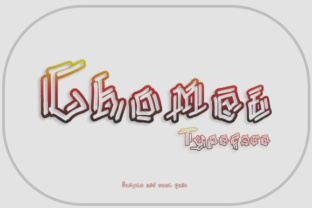
Chomet Brings Personality to Typography Without Overcomplicating Things
There is something refreshing about a typeface that does not try too hard. Chomet, designed by Gblack Id, falls into that rare category where simplicity meets intentional design. It comes with basic punctuation, which might sound minimal on paper, but in practice that restraint opens up a surprising range of possibilities. Whether you are designing a small business flyer, updating your personal blog, or putting together signage for a community event, Chomet offers a clean foundation that does not fight for attention—it just works.
What Chomet Actually Is (and Isn't)
At its core, Chomet is a font that leans into clarity and readability. It is not trying to reinvent letterforms or push avant-garde shapes. Instead, it focuses on giving each character a consistent weight and rhythm. The basic punctuation set covers the essentials—periods, commas, question marks, exclamation points, quotation marks, and a few others—so you can write naturally without worrying about missing glyphs mid-project.
What makes Chomet stand out is how it carries itself. The letters have a grounded feel, not too tall, not too wide, and the spacing is generous enough to avoid that cramped look that cheapens text. If you have ever tried to read a paragraph set in a font that forces letters together, you know how quickly the eyes tire. Chomet avoids that entirely.
Where Chomet Shines in Everyday Projects
The real value of a font shows up not in a spec sheet but in the hands of someone trying to get something done. Chomet fits naturally into several real-world scenarios that designers and non-designers alike encounter regularly.
Small Business Branding on a Budget
When you are running a coffee shop, freelance consultancy, or local retail store, investing in a full custom typeface system is rarely realistic. Chomet gives you a professional look without the price tag. Use it for your menu board headers, social media graphics, or even your store signage. Because the font does not rely on decorative flourishes, it reproduces well at small sizes on mobile screens and at large sizes on printed banners.
One coffee shop owner I know swapped her old script-heavy menu for a clean layout using Chomet for dish names and descriptions. Regulars commented that the menu felt easier to scan, and she noticed fewer customers asking what a particular item was—small detail, meaningful impact.
Independent Publishing and Zines
Self-published zines, poetry chapbooks, and independent newsletters often operate on tight budgets and tighter deadlines. Chomet works beautifully for body text in these formats because it keeps the reading experience smooth. Pair it with a display font for headings, or let Chomet carry the whole publication if you want a cohesive look. The basic punctuation set covers everything you need for standard English text, so you can typeset without hunting for missing characters mid-layout.
Digital Content Creators and Bloggers
If you maintain a blog, newsletter, or YouTube channel, your typography directly affects how long people stay on your page. Chomet works especially well for pull quotes, section headers in long-form articles, and callout boxes. It adds a subtle human touch without screaming for attention. Because the font feels grounded, readers tend to trust it—something that matters when you are trying to build an audience.
Community and Non-Profit Materials
Non-profits and community groups often need to produce flyers, posters, and guides quickly. Chomet handles multilingual names, addresses, and event details cleanly. The consistent weight means you can layer text over photos without losing legibility. A community center coordinator told me they used Chomet for a neighborhood block party flyer and received more RSVPs than in previous years. The font itself did not cause the turnout, but it certainly made the information easier to digest.
Different Users, Different Benefits
Not everyone interacts with a font the same way. Here is how different people might find Chomet useful in their own context.
- Freelance designers often juggle multiple client projects with varying tones. Chomet acts as a reliable fallback when a project calls for something neutral but not boring. It pairs well with display fonts and does not clash with photography-heavy layouts.
- Students and academics working on presentations or posters may not have access to expensive type libraries. Chomet gives their work a polished look that stands up against pricier alternatives. The clarity helps during conference presentations where slides need to be legible from the back of a room.
- Hobbyists and crafters making custom invitations, cards, or scrapbook pages appreciate that Chomet looks clean without feeling cold. It works in both digital and print contexts, so you can design on screen and print at home without surprises.
- Writers and editors who spend hours reading on screens will find Chomet gentle on the eyes. The spacing and proportions reduce fatigue during long editing sessions.
Practical Observations from Using Chomet
After spending time with Chomet in a few projects, some patterns emerge that are worth noting if you are considering it for your own work.
The basic punctuation set is perfectly adequate for most everyday writing. If you are writing standard English text—articles, flyers, correspondence, signage—you will not run into gaps. For anyone working with languages that require additional diacritics or specialized punctuation, it is worth checking the character set upfront.
The font handles text at small sizes particularly well. In a crowded interface or a small sidebar, Chomet remains readable where other fonts become muddy. This matters if you are designing layouts that need to work across devices.
Bold weights carry authority without aggression. Whether you are calling out a sale price or highlighting a key message, Chomet bold stands its ground without overwhelming the surrounding text.
What to Consider Before Committing to Chomet
No font is a universal solution, and Chomet has its own set of considerations that are worth thinking through before you invest time in it.
Consider your audience's reading environment. If your project involves very small sizes, such as footnotes or legal disclaimers, test how Chomet renders at those extremes. While it performs admirably at body text sizes, every font has a breaking point.
Consider the tone you want to strike. Chomet sits in a neutral-to-friendly zone. It is not a formal corporate font, nor is it a playful script. If your project demands high formality or heavy decorative flair, you might need to pair Chomet with a contrasting typeface to hit the right note.
Consider the level of polish you need. Because Chomet is straightforward, the font does not hide design mistakes. A poorly spaced layout will look exactly as disjointed as it is. The font rewards thoughtful composition but does not rescue sloppy work.
Consider your production workflow. If you or your team use design software that requires specific formats, confirm that Chomet is available in the format you need before building a project around it.
Strengths That Keep You Coming Back
Reliability is the word that comes up most when people describe working with Chomet. You know what you are getting. There is no surprise when you switch from one size to another, and the font behaves consistently across platforms. That predictability is valuable when you are juggling tight deadlines.
Versatility is another clear strength. Chomet moves between contexts without feeling out of place. A font that works on a concert poster, a food blog, and a community bulletin is doing something right. It does not lock you into one aesthetic, which gives you room to evolve your visual identity over time.
Readability remains the bedrock. At the end of the day, type exists to be read. Chomet makes that process feel effortless, and that is harder to achieve than most people realize.
Limitations to Keep in Mind
No font is perfect, and Chomet has a few edges that might not suit every situation.
The basic punctuation set, while sufficient for many projects, will feel limiting if you need extensive typographic controls. If you are typesetting mathematical formulas, coding snippets, or multilingual text with complex diacritics, Chomet may not cover all your needs.
The font's straightforward nature means it does not carry a strong personality on its own. If your project relies on typography to convey a specific brand character, you may need to pair Chomet with supporting typefaces or other design elements to build the right mood.
In very long-form reading, some users may prefer a font with more pronounced serifs or more varied letterforms for added rhythm. Chomet's consistent structure can feel uniform over many pages, though many readers actually prefer that consistency for sustained reading.
Making the Most of Chomet in Your Work
Approach Chomet as you would a reliable tool in a workshop. It does not promise to transform your project overnight, but it gives you a solid base to build on. Test it in the actual medium you are designing for—on a real screen at the size you intend to use, printed on the paper stock you have chosen. Those small tests will tell you more than any description can.
If you value clarity, consistency, and a font that stays out of its own way, Chomet deserves a spot in your toolkit. It works hard, asks little, and delivers the kind of quiet professionalism that makes your content easier to engage with. That is a pretty good return on a single typeface.