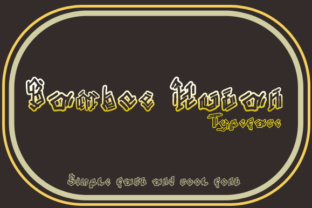
Bamboe Hutan Font: The Raw Character of Jungle-Inspired Typography
When typography moves beyond mere legibility and becomes a vessel for atmosphere and narrative, the result is often something like Bamboe Hutan. This distinctive typeface, crafted by Gblack Id, draws its name and spirit from the dense, untamed growth of bamboo forests. It is not a quiet font. It does not blend into the background. Instead, Bamboe Hutan carries a bold, textured presence that immediately suggests organic strength, handcrafted authenticity, and a certain wildness. For designers, branding specialists, and content creators looking to break away from sterile, predictable typefaces, this font offers a compelling alternative. But what exactly makes Bamboe Hutan stand out, and how does it fit into practical, modern design workflows?
The Design DNA of Bamboe Hutan
At first glance, Bamboe Hutan reveals its core identity: it is a display typeface built for impact. The letterforms are thick, substantial, and carry an irregular, hand-drawn edge. This is not a geometric or perfectly refined font. Instead, each character feels carved or stamped, as if impressed onto paper with a bamboo tool. Gblack Id has deliberately infused the design with an earthy, raw texture that mimics natural materials. The strokes vary in thickness, and the terminals often feel blunt rather than sharp, adding to the sense of ruggedness.
One of the first things designers notice is the weight distribution. The uppercase letters command attention with their blocky, authoritative stance, while the lowercase forms retain a more approachable, almost playful irregularity. This duality is useful. It allows Bamboe Hutan to shout in headlines while still whispering a sense of handmade care in subheadings or short paragraphs. The font includes basic punctuation, which means it can handle standard typographic needs without requiring supplementary fonts for simple sentence structures. Periods, commas, question marks, and quotation marks all carry the same textural DNA, ensuring consistency across a design.
Texture and Imperfection as Features
In an era where digital design often defaults to smooth vectors and pristine curves, the deliberate imperfection of Bamboe Hutan becomes a superpower. The rough edges, uneven stroke weights, and slight variations in each glyph create a tactile quality that is difficult to achieve with standard fonts. This is not a bug in the design; it is the entire point. When used in branding for organic products, eco-conscious companies, outdoor apparel, adventure gear, or artisanal food packaging, this texture communicates authenticity and human effort. It tells the viewer that someone cared enough to make something by hand, even if it is ultimately rendered in pixels or print.
For instance, consider a label for a small-batch craft beer brewed with wild yeast. A clean, corporate sans-serif would feel out of place. Bamboe Hutan, on the other hand, instantly aligns with the rustic, untamed nature of the product. The font itself becomes part of the story, not just a vessel for the words. Similarly, a poster for a jungle trekking expedition or a music festival with a nature theme gains immediate visual depth when the headline is set in Bamboe Hutan. The font does not just display information; it sets a mood.
Practical Applications in Modern Workflows
Designers often hesitate before adopting heavily textured display fonts because of perceived limitations. Can it work in digital interfaces? Will it scale well? How does it behave in different media? Bamboe Hutan answers many of these concerns with surprising flexibility, provided it is used thoughtfully. The key is understanding its role as a specialist rather than a generalist. This is not a body text font for long articles. It is a headline, a hero element, a branding anchor, a visual exclamation point.
Branding and Logo Design
For brand identities that need to evoke nature, toughness, or handcrafted quality, Bamboe Hutan is an immediate asset. A logo built around this font does not require additional decorative elements to convey its message. The letterforms themselves carry the weight of the brand story. A wordmark for an outdoor survival school, a bamboo furniture company, or a sustainable travel blog can stand alone with just the typeface and a simple mark. The font's irregular silhouette also makes it highly recognizable at a glance, which is a crucial advantage in crowded marketplaces where brand recall matters.
However, there is a nuance here. Bamboe Hutan works best when it is paired with simpler, cleaner secondary fonts. A neutral sans-serif like Open Sans or Roboto for body text, captions, or contact details creates a necessary contrast. The interplay between the raw, textured headline and the clean, legible body copy gives the overall design a sense of balance. It prevents the visual fatigue that can occur when a highly decorative font dominates too much space.
Print and Packaging
Bamboe Hutan truly shines in physical media. On a product label, a hang tag, a brochure, or a poster, the texture of the font interacts with the paper stock and printing technique. Letterpress or foil stamping can amplify the handcrafted feel even further. The thick strokes hold ink well, and the irregular edges prevent the design from looking machine-made. For packaging designers working with natural materials like kraft paper, recycled board, or textured stock, Bamboe Hutan feels like a natural extension of the substrate itself.
A practical scenario: imagine a line of organic herbal teas packaged in matte pouches. The product name in Bamboe Hutan, printed in a dark earthy green or brown, immediately signals that this is not a mass-produced commodity. It suggests small-batch care, wild ingredients, and a connection to the forest. The basic punctuation ensures that ingredient lists or brewing instructions, when set in a complementary font, remain professional and usable.
Digital Design and Social Media
In digital spaces, Bamboe Hutan performs well for hero headers on websites, banner images, and social media graphics. Because digital screens display smooth curves by default, the rough edges of the font create an interesting visual tension. It stands out in a feed of polished, cookie-cutter aesthetics. For a brand running an Instagram campaign about an outdoor product launch, using Bamboe Hutan in the graphic's headline makes the post stop the scroll. The font's bold weight also ensures readability at smaller sizes, though designers should test it carefully on mobile screens to avoid losing the texture details at very low resolutions.
One practical consideration: when using Bamboe Hutan on the web, it is wise to pair it with a web-safe fallback font. Not all operating systems will render the font exactly the same way, and the textured details may vary slightly across browsers. Using the font for key visual elements while keeping critical body text in a reliable system font is a sound workflow practice.
What Makes Bamboe Hutan Different from Other Display Fonts
The market is full of display typefaces that claim to be rustic, natural, or handcrafted. Many of them rely on generic brush strokes or predictable grunge effects. Bamboe Hutan, however, has a distinctive personality that feels less like a filter applied to normal letters and more like a coherent design system built from the ground up with a specific material in mind. The reference to bamboo forest—bamboe hutan meaning "forest bamboo" in Indonesian—is not just a name. It informs the verticality, the joint-like stress points in certain letters, and the overall sense of organic growth.
Another distinguishing factor is the consistency of the texture. Some display fonts have rough edges that look artificially distressed, almost like a stamp that has been overused. Bamboe Hutan's texture feels more integrated. The irregularity is present throughout every character, but it never becomes distracting or illegible. This balance is difficult to achieve, and Gblack Id has managed it by keeping the basic letter structures simple and letting the surface treatment do the expressive work.
Considerations Before You Use Bamboe Hutan
No font is perfect for every context, and Bamboe Hutan requires a thoughtful approach. Here are some factors to weigh before committing it to a project:
- Legibility at small sizes: Because of its thick strokes and rough edges, Bamboe Hutan can become muddy when scaled down too far. It works best at sizes above 24 points. For smaller applications, such as captions or fine print, consider using a cleaner companion font.
- Brand personality alignment: This font carries strong connotations of nature, wildness, and handcrafted authenticity. It will clash with corporate, tech-driven, or minimalist luxury brand identities. Know your brand's voice before selecting it.
- Language and character support: Bamboe Hutan includes basic punctuation, but if your project requires extensive diacritics, special characters, or multiple language support, verify that the font covers your needs. Display fonts sometimes have limited character sets.
- File format and licensing: As with any commercial font, ensure you have the proper license for your intended use—whether personal, commercial, or web embedding. Gblack Id provides clear licensing terms, so review them before production.
- Pairing with other fonts: Bamboe Hutan is opinionated. It will not pair well with another equally decorative font. Keep the pairing simple: one bold display font and one neutral, legible body font.
Observations from Real-World Use
Designers who have incorporated Bamboe Hutan into their work often comment on its ability to anchor a visual identity with very little additional effort. A single headline set in this font can define the entire mood of a layout. This is both a strength and a responsibility. When you use Bamboe Hutan, you are making a statement. The font does not allow for half measures. A design that uses it tentatively, perhaps with too much spacing or weak supporting colors, can feel unfinished. But when the font is given room to breathe, set large and bold on a neutral background with ample negative space, the results are striking.
Another observation is the font's effectiveness in monochrome or limited-color palettes. Because the texture and weight carry so much visual interest, Bamboe Hutan does not rely on color to be impactful. A black-on-cream poster, a white-on-charcoal website header, or a single-color label all let the font's character shine without distraction. This makes it an economical choice for projects with tight printing budgets or minimal design resources.
Finally, the font works well in layered compositions. Because its texture is pronounced, you can place semi-transparent images or patterns behind it without losing readability. A photograph of bamboo leaves or tree bark behind a headline set in Bamboe Hutan can create a rich, immersive visual experience that feels cohesive rather than cluttered. This is a technique used effectively in event posters, album covers, and environmental branding.
Final Thoughts on Choosing Bamboe Hutan
Typography is never just about letters. It is about atmosphere, identity, and the subtle signals we send to an audience. Bamboe Hutan, from Gblack Id, offers a specific and powerful signal. It says: this is grounded, this is real, this is made with intention. For designers working on projects that benefit from an organic, wild, or handcrafted aesthetic, this font is a versatile and distinctive tool. It handles headlines, logos, packaging, and digital graphics with a consistent texture that is hard to replicate with other typefaces. The inclusion of basic punctuation means it can also handle simple practical needs without requiring a second font just for periods and commas.
Like any specialized instrument, Bamboe Hutan rewards those who understand its strengths and respect its limitations. It is not a font for every job, but for the right job, it is the only choice. Whether you are building a brand around sustainable living, designing packaging for an artisanal product, or creating promotional material for an outdoor event, Bamboe Hutan brings a forest of meaning along with its letterforms. Use it boldly, use it purposefully, and let its raw character speak for itself.