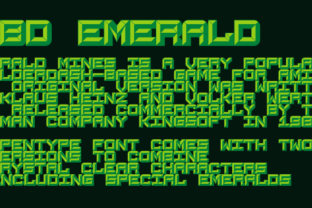
BD Emerald: A Pixel Font That Bridges Nostalgia and Modern Design
Typography has a quiet way of shaping how we experience digital spaces. Among the many typefaces vying for attention in the modern designer’s toolkit, few carry the cultural weight and playful precision of BD Emerald. First released in 2005 by Lopetz Büro Destruct for typedifferent.com, BD Emerald is not just another pixel font. It is a direct descendant of the bitmap lettering used in the classic Commodore Amiga game Emerald Mine — a title that defined puzzle gaming for an entire generation. The font captures the blocky, screen-bound charm of late-80s computing while offering something surprisingly relevant for today’s creative workflows.
What makes BD Emerald especially interesting is that it comes in two versions. By using both version 1 and version 2, designers can introduce a second dimension to their typography — a subtle layering effect that brings depth, movement, and a tactile quality to otherwise flat pixel lettering. This dual-version approach transforms what might seem like a novelty font into a versatile tool for branding, editorial design, digital interfaces, and content creation. Whether you are a seasoned designer or a business owner looking to stand out, BD Emerald offers a grounded, eye-catching way to connect with audiences who value authenticity and a nod to digital heritage.
Why a Pixel Font Still Matters in an Era of High-Resolution Everything
At first glance, a pixel font might feel like a relic. After all, modern screens boast resolutions that make individual pixels nearly invisible. Yet the resurgence of retro aesthetics across branding, web design, and even user interfaces tells a different story. People are increasingly drawn to the honest, unpolished look of pixel typography because it stands in stark contrast to the smooth, often impersonal slickness of vector-based design. BD Emerald fits squarely into this trend, offering a deliberate roughness that signals creativity, playfulness, and a certain hands-on authenticity.
This shift is not just about nostalgia for nostalgia’s sake. It reflects a broader change in how audiences perceive value. In a digital landscape saturated with templated layouts and corporate minimalism, distinctive typography acts as a signal of care and individuality. Marketers, bloggers, and entrepreneurs who adopt fonts like BD Emerald often find that audiences respond more warmly — not because the font is retro per se, but because it feels intentional. It suggests that someone took the time to craft a visual identity that does not blend in.
Moreover, the practical advantages of pixel fonts in certain contexts are undeniable. At small sizes, bitmap fonts like BD Emerald maintain crisp legibility where anti-aliased fonts can become blurry. This makes them ideal for user interfaces, game design, heads-up displays, and any scenario where clarity at low resolutions matters. For educators creating printable worksheets or hobbyists building indie games, BD Emerald provides a reliable, readable option that feels both functional and evocative.
The Two-Version System: How Depth Emerges from Simplicity
The most distinctive feature of BD Emerald is its dual-version design. Version 1 offers the standard pixel lettering — clean, blocky, and immediately recognizable to anyone familiar with the Commodore Amiga era. Version 2, on the other hand, introduces subtle variations in weight and spacing that, when layered over version 1, create a sense of depth. This is not a simple bold or italic variant; it is a carefully crafted second pass that adds visual texture without sacrificing the font’s essential pixel character.
For designers, this creates opportunities that a single-version pixel font cannot match. You can use version 1 for primary text and version 2 for accents, drop shadows, or layered headlines. The effect is reminiscent of early 3D games and demoscene graphics, where limited hardware forced creators to find clever ways to suggest volume and motion. BD Emerald channels that same inventive spirit into a modern typographic tool.
Practical examples abound. A freelance developer building a retro-themed portfolio site might set main headings in version 1 and use version 2 as a subtle offset layer to simulate a shadow effect without relying on CSS filters. A small business owner creating social media graphics could pair both versions to build a distinctive, consistent brand voice that feels both technical and approachable. Even in video title cards or podcast cover art, the two-version system adds a visual richness that stands out in crowded feeds.
From Emerald Mine to Modern Workflows: A Natural Evolution
The origins of BD Emerald trace back to Emerald Mine, a puzzle game released for the Commodore Amiga in the late 1980s. Players navigated a miner through underground caverns, collecting gems while avoiding hazards. The game’s pixel art and bitmap fonts were quintessential products of their time — functional, charming, and bound by the constraints of 16-bit hardware. Lopetz Büro Destruct recognized that this particular letterform had a unique balance of readability and character that deserved a second life beyond the game.
In the years since its 2005 release, BD Emerald has found its way into a variety of creative projects, from indie game UI to event posters to retro-ware packaging. Its relevance has actually grown as the broader culture has cycled back to celebrating the aesthetics of early digital media. Current trends in glitch art, vaporwave, synthwave, and pixel art revivalism all owe a debt to typefaces like BD Emerald that preserve the visual language of a formative era in computing.
What is especially noteworthy is how the font transcends its gaming roots. While it certainly appeals to gamers and collectors, BD Emerald has also been adopted by educators creating visually engaging worksheets, by bloggers who want their headlines to feel distinct, and by marketers running campaigns that target demographics who remember the Amiga era — as well as younger audiences who discover retro aesthetics through social media and indie culture.
Practical Implications for Creators and Professionals
For anyone building a visual brand today, the choice of typeface is never trivial. A font like BD Emerald communicates values before a single word is read. It says that you prioritize character over conformity. It suggests that you are willing to take design risks in pursuit of a memorable identity. For freelancers and small business owners, this can be a powerful differentiator in a market where most competitors rely on safe, generic typography.
Content creators — from YouTubers to newsletter writers — can use BD Emerald to create a consistent visual signature across thumbnails, headers, and merchandise. Because the font is available in two versions, it allows for hierarchical variety within a single typeface family, reducing the need to mix multiple fonts that may clash. This streamlining is especially valuable for anyone who produces a high volume of content and needs a reliable, repeatable look.
For web designers and front-end developers, BD Emerald works well in contexts where a retro or industrial feel is appropriate. It pairs naturally with monospaced fonts, bold sans-serifs, and even certain slab serifs. Its pixel structure also makes it a strong candidate for responsive design testing at smaller viewport sizes, where its legibility remains intact.
Even for hobbyists — someone building a retro game in Unity, designing a zine, or creating a custom workstation desktop theme — BD Emerald offers a direct link to the Amiga’s design philosophy. It is not just a font; it is a piece of digital history made usable again.
How to Get the Most Out of BD Emerald
Using BD Emerald effectively means understanding its strengths and its limits. Here are a few grounded recommendations based on real-world use:
Consider the Context
BD Emerald shines in short-form text — headlines, labels, buttons, logotypes, and short paragraphs. Because it is a bitmap font, extended reading sections can cause eye strain at small sizes. Reserve it for moments where you want maximum impact, and pair it with a clean, readable sans-serif for body copy.
Layer Both Versions Intentionally
The real power of BD Emerald emerges when you use version 1 and version 2 together. Try setting version 1 in a bright color and version 2 as a darker offset behind it, or invert the relationship for a ghosted, ethereal effect. Experiment with opacity and spacing to create the depth that works for your project.
Stay True to the Pixel Grid
Avoid scaling BD Emerald in ways that distort its pixel structure. Because bitmap fonts are designed at specific sizes, scaling them to non-integer multiples can create uneven pixel clusters. Stick to sizes that respect the original grid, or use version 2’s variations to achieve visual interest without breaking the pixel integrity.
Combine with Modern Design Elements
BD Emerald pairs surprisingly well with contemporary design elements: gradient overlays, subtle shadows, dynamic layouts, and even animation. The contrast between the rigid pixel edges and modern smoothness creates a compelling tension that feels fresh, not dated.
Looking Ahead: Why BD Emerald Will Keep Its Place
Typography trends come and go, but fonts rooted in a genuine historical and technical context tend to endure. BD Emerald is not a passing fad. It represents a specific moment in computing history — the era of the Commodore Amiga and the golden age of puzzle gaming — while offering a structural innovation (the two-version system) that remains genuinely useful. As long as designers and creators value authenticity, distinctiveness, and functional beauty, BD Emerald will have a place in their type library.
Moreover, the broader movement toward personal, handcrafted digital experiences shows no sign of slowing down. Audiences are tired of generic stock photography, templated websites, and safe color palettes. They want to see the human hand at work. A font like BD Emerald, with its pixel legacy and dual-version depth, signals that someone cared about the visual details. That kind of care builds trust, recognition, and emotional connection — for businesses, creators, and anyone who communicates with the written word.
Whether you are designing a game, building a brand, or just looking for a way to make your next project feel more intentional, BD Emerald offers a proven, grounded path. It is a reminder that sometimes the most forward-looking design choices come from looking back with respect and imagination.