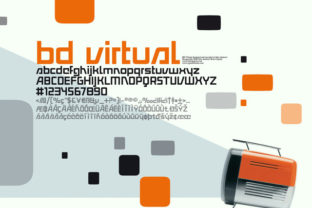
BD Virtual: A Strategic Approach to Geometric Typography for Branding and Communication
Typography is rarely the first consideration in a project plan. Yet it quietly shapes perception, comprehension, and recall. When you choose a typeface, you are making a decision about how your audience will process information, assign credibility, and remember your message. BD Virtual, a clean geometric font designed for titling and logotypes, offers something specific: clarity without compromise. Released in 2008 by Lopetz, Büro Destruct, and typedifferent.com, it has found natural resonance among architects and design professionals. But its strategic value extends far beyond that niche.
This article explores what BD Virtual is, why it deserves a deliberate place in your toolkit, and how to use it with intention rather than impulse. Whether you are a small business owner refining your visual identity, a marketer planning a campaign, or a creator building a portfolio, understanding the rationale behind a typeface choice can lead to better outcomes.
What Makes BD Virtual Distinct
BD Virtual belongs to the geometric sans-serif tradition. Its letterforms are constructed from precise, almost mathematical shapes. Circles, straight lines, and consistent stroke weights dominate. There is no ornament, no flourish, no attempt to mimic handwriting or historical calligraphy. This is a font that states its purpose plainly: to be read clearly and to project a sense of order.
Architects frequently gravitate toward such typefaces because the visual language mirrors their own design principles. Clean lines, modular thinking, and a rejection of superfluous detail are core to modern architecture. BD Virtual aligns with that worldview. For anyone in branding, communication, or content creation, this alignment can be leveraged when you want to convey precision, rationality, or forward-thinking simplicity.
The font is primarily intended for titling and logotypes. It is not a text face optimized for long paragraphs. This constraint is not a weakness; it is a strategic parameter. Knowing that BD Virtual performs best at larger sizes, in short strings, and in contexts where readability must be immediate allows you to deploy it where it will have the greatest impact.
Brand Identity and Positioning
If your brand needs to communicate clarity, innovation, or professionalism, BD Virtual can serve as a visual shorthand. A logotype set in this typeface signals that you value structure and transparency. It works well for technology companies, consultancies, design studios, and educational platforms. It is less suited for brands that rely on warmth, tradition, or organic feel—but that is precisely the point. The right typeface eliminates ambiguity about your positioning.
When planning a brand refresh or new identity, consider what emotional and rational messages your logo must carry. BD Virtual can anchor those messages with minimal visual noise. Pair it with a more readable text typeface for body copy, and you create a clear hierarchy: the title commands attention, the body informs.
Editorial and Content Design
For magazines, reports, white papers, or online publications, titling carries the burden of first impressions. BD Virtual gives you a way to make headings and section titles feel deliberate and modern. It works particularly well in digital environments where screen rendering can make ornate typefaces look muddy. Its geometric clarity holds up at various resolutions.
If you produce long-form content, using BD Virtual exclusively for headings and key callouts creates a visual rhythm. Readers learn to recognize the typeface as a signal of importance. This supports information hierarchy and improves navigation, especially in documents where skimming is common.
Presentation and Communication Materials
Slides, pitch decks, and one-pagers benefit from typefaces that reduce cognitive load. BD Virtual, with its clean lines and uniform stroke weight, allows your audience to focus on your message rather than deciphering your typography. When you are presenting complex data or a new strategy, the last thing you want is a font that introduces visual friction.
Consider using BD Virtual for slide titles, key quotes, and data callouts. Keep body text in a companion font designed for extended reading. This pairing respects the audience's attention and reinforces your credibility as a communicator who has thought about the details.
Planning Your Typography System
Typeface selection is not an isolated decision. It belongs within a broader typographic system that includes hierarchy, spacing, color, and context. Before committing to BD Virtual, take time to map out how it will function across your materials.
Start with a list of all touchpoints: website, social media graphics, printed collateral, presentations, signage, email templates. For each, determine where titling occurs and at what size. BD Virtual performs best when it has room to breathe. If it will appear at very small sizes or on low-resolution screens, test it thoroughly. Geometric typefaces can sometimes lose legibility at small scales because of tight apertures or uniform shapes.
Next, choose a complementary typeface for body copy. A serif or humanist sans-serif often pairs well with a geometric titling face. The contrast between the two creates visual interest and signals a shift in function. This pairing also supports accessibility, as body text needs different characteristics than display text.
Finally, establish guidelines for usage. When should BD Virtual appear? How much space should surround it? What colors and backgrounds work best? Document these decisions so that anyone on your team can apply them consistently. Consistency builds recognition, and recognition builds trust.
Risks of Using BD Virtual Without Clear Goals
Every tool has limitations. BD Virtual is no exception. Using it without a clear purpose can undermine your communication in several ways.
One common risk is overuse. Because it looks clean and modern, there is a temptation to apply it everywhere. But BD Virtual is not designed for extended reading. If you set large blocks of text in it, readers may experience fatigue. The uniform geometry, while visually appealing at large sizes, lacks the subtle variations that make long-form reading comfortable.
Another risk is misalignment with brand personality. If your brand values warmth, approachability, or tradition, a rigid geometric typeface can create dissonance. Your audience may sense that something is off without being able to articulate why. They will simply feel less connected to your message.
There is also the risk of following a trend rather than a strategy. Geometric typefaces have enjoyed popularity in certain design circles, but popularity does not equal fit. Choosing BD Virtual because others have used it, without evaluating your own context, can lead to a generic or borrowed identity. Your brand should look like itself, not like a collection of current design trends.
To mitigate these risks, always ask: What goal does this typeface serve in this specific context? If the answer is clear and measurable, proceed. If the answer is vague or borrowed, pause and reassess.
Long-Term Value of Intentional Typography
Typography is not a one-time decision. It compounds over time. Every piece of content you produce reinforces or erodes the perceptions you have built. When you commit to a typeface like BD Virtual in a strategic way, you are investing in a consistent visual language. That consistency makes your brand easier to recognize, easier to remember, and easier to trust.
Over the long term, this pays dividends in customer acquisition, retention, and advocacy. People gravitate toward brands that feel coherent. They are more likely to recommend a brand that looks professional and purposeful. While no single typeface guarantees these outcomes, a thoughtful typography system supports them.
BD Virtual, used where it excels—headings, logos, short display text—can become a visual anchor for your brand. When audiences see it repeatedly in controlled contexts, they begin to associate its clean geometry with your organization's values. That association becomes a subtle but persistent advantage.
Practical Decision-Making Guidance
If you are considering BD Virtual for a project, walk through a few practical steps before committing.
- Test in context. Place your logotype or headline in the actual environment where it will appear. View it on a screen, on a printed page, at different sizes, and beside your body typeface. Does it hold up? Does it feel aligned with your message?
- Compare alternatives. There are many geometric typefaces. Test two or three others alongside BD Virtual. The differences may be subtle, but one will likely feel more appropriate for your specific use. Trust that intuition after you have gathered enough evidence.
- Consider licensing and availability. BD Virtual is available through typedifferent.com. Ensure you have the correct license for your usage—commercial, web, print, or all of the above. Licensing is a small cost compared to the effort of rebranding later.
- Plan for evolution. Brand identities change. Your typeface choice should be flexible enough to evolve with your organization. BD Virtual's clean geometry makes it adaptable to many contexts, but consider whether it will still serve you in five or ten years.
- Involve stakeholders early. If you work within a team, share your rationale for choosing BD Virtual. Explain how it supports your goals. When others understand the reasoning, they are more likely to apply it consistently and defend it when challenged.
Conclusion
BD Virtual is a tool, not a solution. Its value depends entirely on how and why you use it. When deployed with intention, it can strengthen your brand, clarify your communication, and support your long-term goals. When used without thought, it can add noise and confusion.
The best decisions in design and communication come from understanding both the tool and the context. BD Virtual offers clean geometry, clear hierarchy, and a modern sensibility. Your job is to determine where those qualities serve your audience and your objectives. Start with strategy, end with execution, and let the typeface support the message you already know you need to deliver.