Understanding Summerrine: A Geometric Font Built for Clarity and Global Reach
Fonts shape how we read, feel, and interact with information. Every typeface carries a personality — some feel friendly and warm, others strict and formal. Summerrine belongs to a distinct category: the geometric sans-serif. But what truly sets it apart is its deliberate absence of rounded elements and its robust support for multiple writing systems, including Cyrillic. Whether you are a designer, a business owner building a brand, or simply someone curious about typography, understanding what makes Summerrine unique can help you make better visual choices.
What Is a Geometric Font?
Before diving into Summerrine specifically, it helps to understand what geometric means in typography. A geometric typeface is built on simple, regular shapes — circles, squares, and straight lines. Unlike humanist or grotesque fonts, which may borrow curves from handwriting or organic forms, geometric fonts rely on mathematical precision.
Famous examples include Futura, Century Gothic, and Avenir. These fonts feel clean, modern, and often minimal. But not all geometric fonts are the same. Some soften their edges with rounded corners or smooth terminals. Summerrine takes a different approach: it embraces sharp, unrounded geometry throughout.
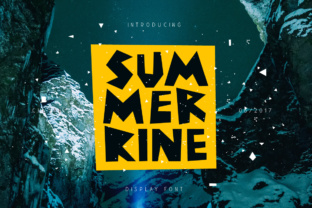
This means every character — from the capital A to the lowercase z — is constructed with straight lines and exact angles. There are no soft curves or rounded bowls. The result is a typeface that feels precise, direct, and uncompromising.
The Design Philosophy Behind Summerrine
Why choose a font without rounded elements? The decision is both aesthetic and functional. Round shapes in type can suggest warmth, approachability, or informality. Sharp, straight forms suggest structure, efficiency, and clarity. Summerrine aligns with the latter philosophy.
Its design emphasizes:
- Consistency: Each letterform follows the same geometric logic, creating visual harmony across words and blocks of text.
- Legibility: Without decorative curves or flourishes, each character stands out clearly, even at smaller sizes.
- Modernity: The unrounded look feels contemporary and technical, fitting for digital interfaces, branding, and signage.
In a world where many fonts try to be friendly or decorative, Summerrine commits to being clear. It doesn't distract. It communicates.
Full Character Set: Lowercase, Uppercase, and Everything In Between
One of Summerrine's strengths is its completeness. It includes a full set of uppercase and lowercase letters. This might sound basic, but not all fonts offer both in a consistent style. Some display fonts only come in uppercase, or have mismatched weights. Summerrine provides a unified system.
Beyond letters, it contains:
- A large range of punctuation — periods, commas, colons, semicolons, quotation marks, brackets, dashes, and more.
- Numerals — lining figures that align perfectly with the uppercase height, making them ideal for tables, prices, and data.
- Cyrillic characters — supporting languages like Russian, Bulgarian, Serbian, Ukrainian, and others.
This breadth matters more than most people realize. A font that lacks punctuation or numerals forces designers to mix typefaces, which can break consistency. Summerrine avoids that problem entirely.
International Support and the Role of Cyrillic
Typography doesn't end with the Latin alphabet. Over 250 million people use the Cyrillic script daily. For brands, publications, and software that serve global audiences, including Cyrillic is not optional — it's essential.
Summerrine includes a full set of Cyrillic characters, designed in the same geometric, unrounded style as its Latin counterparts. This means a Russian-language website, a Bulgarian product label, or a Serbian mobile app can all use the same typeface without visual compromise.
International support also extends to diacritics and special characters used in Central and Eastern European languages. This makes Summerrine a practical choice for multinational projects where consistency across languages is critical.
Why This Matters for Business and Branding
Consistency builds trust. When a brand uses the same typeface across English, Russian, and German materials, it signals professionalism and attention to detail. Mixing fonts — or worse, using a font that lacks certain characters — creates friction. Customers notice when something looks "off," even if they can't name why.
Summerrine solves this. Its Unicode support covers a wide range of Latin-based and Cyrillic languages, making it a one-typeface solution for international branding.
Practical Applications of Summerrine
Where does a geometric, unrounded font fit best? Here are several real-world contexts where Summerrine shines:
Digital Interfaces and UI Design
Screen readability depends on clarity. Sharp, geometric letterforms render well at various sizes, from headlines to body text. In user interfaces, where space is tight and legibility is paramount, Summerrine's clean lines help users scan information quickly. Buttons, labels, and navigation menus all benefit from its structured appearance.
Branding and Corporate Identity
Companies that want to project precision, innovation, or engineering expertise often choose geometric fonts. Summerrine's lack of rounded elements reinforces a no-nonsense, forward-looking image. Tech startups, architectural firms, and financial services can all use it to communicate reliability and focus.
Editorial and Print Design
In magazines, reports, or posters, Summerrine works well for headlines and pull quotes. Its consistent geometry creates a strong visual rhythm. For body text, it pairs particularly well with a more readable serif or humanist sans, but for short blocks or captioning, it stands on its own.
Signage and Wayfinding
Signs need to be legible from a distance and in poor lighting. Geometric fonts with open counters and simple shapes perform well in these conditions. Summerrine's unrounded letters reduce visual noise, making directions and labels easier to process at a glance.
Common Misunderstandings About Geometric Fonts
When people first encounter a font like Summerrine, they sometimes assume it is cold or impersonal. This is a misunderstanding. Geometric typefaces are not devoid of personality — they simply express it through structure rather than ornament. In the right context, that structure feels confident and sophisticated, not distant.
Another misconception is that geometric fonts lack versatility. Some believe they only work for modern, minimalist projects. In reality, Summerrine can adapt across many visual styles when paired thoughtfully with complementary colors, imagery, and spacing. Its neutrality is a strength, not a limitation.
A third assumption is that a font without rounded elements must be hard to read. But legibility depends on many factors — spacing, stroke contrast, and character distinction. Summerrine's design addresses these carefully. Its straight lines are not cramped or monotonous; they are proportioned to make each letter distinct.
How Summerrine Fits Into Modern Workflows
Designers today need typefaces that work across media — print, web, mobile, and video. Summerrine is available in common formats and integrates well with design tools like Adobe Creative Suite, Figma, and web platforms. Its consistent metrics simplify spacing and alignment.
For web developers, Summerrine can be embedded via CSS @font-face or loaded from a type service. Its clean geometry renders smoothly on screens, and its language support reduces the need for fallback fonts. This means fewer font loads, faster page speeds, and a more consistent user experience across languages.
For content creators and educators, Summerrine is useful for presentations, infographics, and instructional materials. Its clear letterforms help learners focus on content rather than deciphering complicated typography.
Choosing Summerrine: Questions to Consider
If you are evaluating Summerrine for a project, here are some points to think about:
- Does your project need a clean, modern look? Summerrine delivers that without relying on decorative elements.
- Are you working across multiple languages? Its Cyrillic and extended Latin support makes it a strong candidate.
- Do you want a font that feels stable and reliable? Its geometric precision conveys exactly that.
- Are you pairing it with other typefaces? Summerrine works well as a display or heading font alongside more organic text faces.
- Does your audience include users from Eastern Europe or Central Asia? Including Cyrillic support is a sign of respect and professionalism.
Not every project needs a geometric font. But for those that do, Summerrine offers a distinctive combination of sharpness, completeness, and international readiness.
Final Thoughts
Summerrine represents a thoughtful approach to type design. It is not trying to be friendly or playful. It is trying to be clear. By removing rounded elements, it focuses attention on structure and readability. By including a full character set with Cyrillic support, it serves a global audience that many fonts ignore.
Whether you are designing a corporate website, building a bilingual app, or creating a poster for an international event, Summerrine gives you a solid, trustworthy foundation. Its geometric backbone ensures consistency. Its lack of frills ensures clarity. And its comprehensive language support ensures that your message reaches the people who matter — wherever they are and whatever alphabet they read.
Typography is a quiet but powerful tool. The right typeface can make information easier to absorb, a brand more memorable, and a user experience more seamless. Summerrine earns its place in the toolbox of anyone who values precision, reach, and purposeful design.